



I have a friend who works in logistics. The last time we spoke, he told me a story about a stressful situation he was dealing with at work. Tensions were high internally over a somewhat trivial matter, but to the individuals involved, lines had been drawn, and folks were dug into their own version of reality. My level-headed friend told me how he spent several days talking to each stakeholder, how he dove deep into dozens of email threads, and how he eventually constructed an evenhanded picture of the situation that quickly defused the tension. He described his effort as “Corporate Anthropology.” I may have heard the term before, but this was the first time it struck me as worth deeper analysis.
According to this article from the University of Pennsylvania, organizational anthropology “applies the global insights of anthropology as an academic discipline to illuminate the problems and situations we encounter in the everyday groups and organizations in which we all participate every day.” The discipline started in the 1990s as a way of dissecting the unseen and unspoken human influences that shape company cultures and performance.
The idea is to use the full toolkit of scientific methods to gather both quantitative and qualitative data about why people in an organization behave the way they do, even when it’s antithetical to the stated corporate culture or goals. It seeks to identify specific behaviors in an organization and to understand them in a broader anthropological context. For instance, if you’re expanding your operation to the West Coast, you may find that cultural differences between East Coast and West Coast teams create friction you didn’t anticipate. You may find that teams struggle with the time difference, or that your New York office staff speaks more directly than an office in Los Angeles. These symptoms may first present as two teams that don’t work well together, but the root causes become apparent only after you’ve done the anthropological work.
We’ve leaned into this anthropological approach in how we execute strategy for our client partners. We constantly remind ourselves and our clients that, in order to build a great product, we must remove the biases of the people in the room and better understand the people we’re building for. Every project starts with user personas, not just to establish who we’re working for, but to understand their motivations and behaviors. We ask about users’ education levels so we can establish a baseline comprehension level for content writing. We ask about age because we can use current demographic data to understand which screen sizes and orientations are primary for most users. We ask about lifestyle so we can make informed decisions about how much time each user wants to spend learning versus performing a task.
All the knowledge we gain from these questions is applied to currently available demographic research. It’s an ongoing effort because society is always changing. For instance, today’s high school graduates are reading at a level well below what was expected even ten years ago. The National Center for Education Statistics described this as an “unprecedented decline” between pre-pandemic (2020) and post-pandemic (2022) assessments, with reading scores falling to levels last seen in the early 2000s (source). So, a site with a general audience should respond in kind if the goal is to appeal to the general population, or push for a higher reading level if the goal is to educate. In this instance, we’re gathering qualitative data from the client, checking it against available quantitative data, and suggesting a solution that aligns with organizational goals.
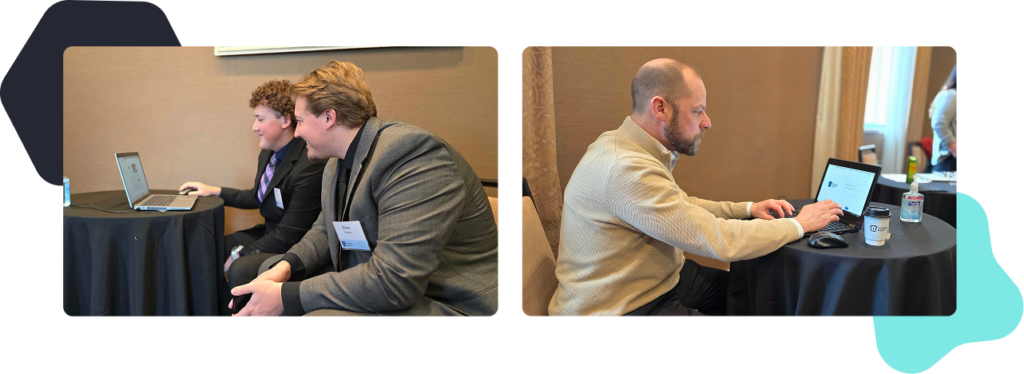
Good anthropology requires deep dives into culture. To do this, we believe that to truly understand how an organization works, you have to talk to people on the ground. Our strategy projects include hour-long sessions with representatives from each department we’re working with, not just managers. We find it invaluable to hear from front- and back-end users about how they’re actually using the tools, versus how they’re expected to use them. We ask them questions about the physical environment in which they’re using the interface. We ask them how they work around limited functionality that we plan to expand. Finally, we ask whether there’s anyone else we should speak with to better understand the situation on the ground. All of these questions provide a qualitative overview of the organization’s culture beyond technology use.
Our final step in understanding the culture into which we release a product is product testing. We employ a host of pre- and post-launch techniques to test the decisions we made against users’ actual behavior. This can take the form of prototype testing with a tool like Useberry or analytics tools like Google Analytics and Hotjar. These tools provide quantitative and qualitative validation for the decisions we made based on the insights we gathered during strategy.
This all stems from our core values of “adapt and learn” and “constant improvement.” Like any other science, corporate anthropology is ever-evolving as our data collection techniques improve, and culture shifts. We’re never precious about our approach, always integrating new strategies to delve deep into the cultures of the partners we work with and to understand the micro- and macro-level forces that shape the behaviors of the individuals for whom we build products. It always comes back to the user.

Jacob Trunk
Creative Strategy Director
Jake Trunk is our Creative Strategy Director. He brings a passion for creativity, sound design principles, and a desire to provide delightful digital experiences. Jake is always eager to walk our clients through the process of understanding their users, identifying the users’ needs, and creating digital products that help them accomplish their goals. His aim is to always provide innovative and intuitive solutions to digital problems. Jake brings skills in all kinds of creative mediums from digital illustration to website prototyping, and he believes that the muscles of creativity grow stronger not only with repetition but with stretching. Outside of work, Jake can be found in his art studio working on his latest paintings, or spending time with his wife and two small kids.
Related Articles

The Return of Craft in a World of AI Design
-

 Jacob Trunk
 - |
- July 30, 2026
- |
- 5 min read
There’s a production studio in Hillsboro, Oregon called Laika. They specialize in stop motion animation. They produced the benchmark-setting Coraline in 2009, redefining what a stop motion movie can achieve. For their production Kubo and the Two Strings, they released time-lapse videos of the grueling two-day-long process of shooting a few seconds worth of a […]

AI Won’t Fix a Data Problem. It’ll Crank It Up to 11.
-
 Tim Haak
 - |
- July 16, 2026
- |
- 7 min read
Why data maturity has to come before your AI strategy, and what to do about it. I’ve been thinking about data a lot lately. Every organization has been amassing mountains of data by using various products, systems, and tools for many years. At the same time, a lot of folks are excited about how AI […]

The Era of the Toxic Rebrand
-
Jacob Trunk
- |
- April 30, 2026
- |
- 4 min read
One of my favorite pastimes is walking around art museums, and our corner of Philadelphia has no shortage of them. The Barnes Foundation offers a unique perspective on late 19th and early 20th-century contemporary art. The Rodin Museum makes the artist’s unique vision personal by laying out his process alongside his finished works. But the […]